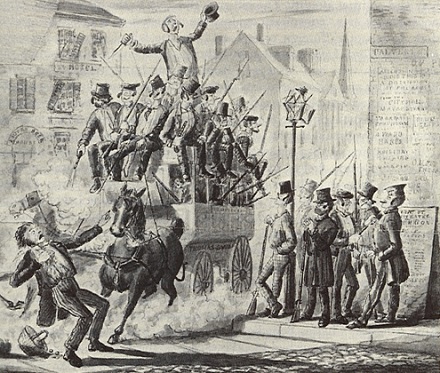
Vehicle of the Revolution

The Relationship Between the Continental Army and the Militia During the American War of Independence

Monmouth

Webster’s New Collegiate Dictionary has five entries for the definition of revolution: the first three deal with physics and celestial bodies; definition four states “a total or radical change;” and definition five is “a fundamental change in political organization…the overthrow or renunciation of one government or ruler and the substitution of another, by the governed.”   Inherent to all of revolutions of the political change-type characterized by definition five is the use of violence by both revolutionaries and the existing government, often taking place on a large scale.  This violence becomes the means by which the ideas of the revolution are transferred in to actions – the actual revolution itself.  Using terms from physics as a metaphor (in keeping with Webster’s first three definitions or revolution), the ideas espoused by revolutionaries (liberty, free trade, independence, etc.) represent the potential energy of the revolution, generating tension between the movement and the existing political structure.  When released, this tension becomes kinetic energy – energy in motion, or the action of the revolution – involving the violence necessary to overcome the resistance of forceful objection posed by the political establishment.  But unlike other expressions of violence involving large groups such as bread riots, pogroms, and lynching, which are shorter in span and more anarchical in nature, the violence of revolution (if it is to be successful) is directed, controlled, and sustained over a longer period of time and against determined opposition.  To achieve this, revolutions utilize military structure to provide the necessary means of organization and control; the kinetic energy of revolutionary violence is guided toward the realization of the revolutionary goal.  An army, then, can be considered a vehicle of revolution, giving leaders a structural mode, enabling them to drive the course of revolutionary violence toward independence.  Such was the function of the Continental Army during the American Revolution.

Subordination of the new military establishment to Congress was the crucial factor in enabling American revolutionaries to sustain and control the progress of the American Revolution, which, of course after 1776 defined its success solely on the achievement of independence.  As long as the British maintained a military presence within the new United States, independence could not be realized.  So long as the Americans were able to resist the British military, they would be actively pursuing independence.  This resistance could have been accomplished without a standing army, of course, and the American Revolution did have a substantial, and effective, guerrilla aspect to it, especially on the frontiers and in the South, but as Don Higginbotham, citing the German General von Clausewitz, notes in War and Society, while “rarely indeed are orthodox forces ever successful against guerrillas” partisan action alone “seldom brings about total victory in war.”  Thus for the Americans to realize success, “the final blow” would have to be “delivered by large, well-organized armies working in smooth harmony.”  Higginbotham points out that this turned out to be the case when “French and American forces in cooperation with the French fleet trapped Cornwallis at Yorktown and hammered him into submission.”[1] Yet even with the realization that an army was necessary for victory, many scholars of the American Revolution consider the adoption of a regular army to be a great leap on the part of the revolutionaries given “the ingrained Anglo-American distrust of the military,” and their favoring of a yeoman militia over the danger of a standing army.[2] Don Higginbotham suggests that this glorification of the militia may be more a product of rhetoric and idealism than true practice of the time.  He states “that militia reflected the ‘country’ (or classical republican) ideology which was appealing to the revolutionists [and early American historians]” while “standing armies mirrored the ‘court’ (or Walpolian consolidated-mercantilist) ideology.”[3] The fact is, however, the colonies were keeping semiprofessional forces at the ready even in the early 1700s.  Following Queen Anne’s War, for example, “Massachusetts maintained a small, permanent military establishment, which occupied frontier posts in Maine and garrisoned Castle William,” and Connecticut had “switched from militia drafts and other compulsory steps to enlistment bounties as early as 1710.”[4]  Both instances demonstrate an acceptance of regular military practice, rather than absolute distrust.  In 1756, a young colonel Washington sought the recognition of British authorities, insisting to Lord Loudoun that the Virginia Regiment (which Washington commanded) “were not militia – for which they [the provincial officers], like Washington, had great contempt – at the same time they argued for regular status.”[5]

This is not to dispel the fact that many revolutionaries who took up the cause included a distrust of standing armies (like the one the British were maintaining in Boston and New York) in their list of grievances and as a motivation behind the revolt.  Charles Royster emphasizes in A Revolutionary People at War that for many Americans the concept of a regular army ran counter to their concepts and ideas of virtue and liberty.  Jonathan Rossie cites the 1775 writings of “Caractacus” which were printed in a Philadelphia newspaper and “not only condemned regular armies but also a paid militia – by accepting pay, a militiaman was transformed into a mercenary.”  The acceptance of pay would erode the principles and warp the loyalties of the fighting man, so the contention went, thus a “standing army would subvert and ultimately destroy the very liberties it was meant to protect.”  “Caractacus” extolled the benefits of a ready militia “capable of responding at a moment’s notice to any move of the enemy,” vigilant and virtuous, the militia embodied the ideal union of citizen and soldier.[6]

But were the two, militia and Continental, so dramatically different?  Were the militia truly composed of yeoman farmers while the Continental Army was drawn from the dregs of society, ready to follow any general promising enough pay and trounce upon the very liberty revolutionaries were fighting for?  Royster acknowledges that through “careful collation of enlistment rolls and civil records, scholars are drawing composite pictures of” the class of men who filled the ranks of the regular army.  He draws particularly upon the work of Edward Papenfuse and Gregory Stiverson, “General Smallwood’s Recruits: The Peacetime Career of the Revolutionary War Private,” which examines the muster rolls of recruits in Maryland in 1782.  They conclude that the majority of the men in their study “enlisted in the army not because of a sense of duty or patriotism, but because Maryland society offered few other opportunities for employment.”[7]  Taking exception with this premise, Royster contends that “able-bodied young men who sought their own material well-being above all else had alternatives better than service in the Continental Army,” among which were privateering and farm labor.  Faced with the threat of death or disfigurement by combat or disease, Royster asserts, “the distinguishing feature of the [regular] recruits was their willingness” to serve in the army.[8]  John Resch, in Suffering Soldiers, concurs with Royster and disputes the conclusions of “most historians” that “Continental soldiers came largely from society’s poor, propertyless, transient, and marginalized,” taking particular exception with the “forceful” position of historian Charles Neimeyer that the majority of regulars were “low class.”  Resch bases his contrarian position upon his study of the Revolutionary soldiers from Petersborough, New Hampshire, “Continental and non-Continental.”  “Rather than being segregated by class,” he contends, “enlistments from Petersborough throughout the war represented a cross section of the town’s society.”[9] Essentially both Royster and Resch, and to some extent Richard LaCrosse in Revolutionary Rangers, suggest that the men who joined the ranks of the Continental Army, though serving for pay, demonstrated just as much patriotism as the state militiamen who mustered for only brief periods.  The advantage for the militia was that once the operations concluded, they were able to go back to their homes and resume their employment.  Those regular soldiers serving longer enlistments followed the enemy as the war progressed southward through the states, leaving homes and the ability to earn money outside of the military behind.

It is important to note that only in rare instances did the American’s face their enemy with a force composed solely of either militia or Continental troops.  A few notable victories such as Bennington and King’s Mountain stand out as examples of militia only successes, but the majority of campaigns fought by the American army required the contributions of both elements.  Don Higginbotham notes, that “in Washington’s view, the Continentals and militia had separate, although mutually supportive roles to play.”[10]  The militia were best at hit-and-run tactics, and though there were times when they were required to support the Continental line in formal engagements, “performing against redcoats in open combat” (a function in which, Higginbotham notes, the “militia were at their worst”), the “amateur” soldiers proved extremely successful at denying extensive British and loyalist areas of control and creating a generally hostile environment which forced the British to receive substantial amounts of their “supplies and provisions…from the mother country.”[11]  The Continental line would provide continuity to the war effort, following the British as the war moved from theater to theater.  As Higginbotham writes, “the presence of the Continental Army intact offered Americans a symbol of unity” creating a “national feeling” and presenting “a sign of conventional military strength” to the new country and the rest of the world, “where patriots hoped to get tangible support.”[12]  Militia participation, not surprisingly, would increase and decrease with the threat posed by the enemy in a particular region.  Here John Resch’s study of the Petersborough soldiers provides a convincing illustration of the wax and wane of localized participation in the Revolution.  After the initial wave of enlistments at the outbreak of war in 1775, the Petersborough “contribution to the war effort dropped substantially in 1776 following American defeats in Canada and British evacuation of Boston.”[13]  The following year, in which Burgoyne invaded New York, saw the “highest proportion of Petersborough men at any period of the war” under arms, bolstering the militia at Bennington and Saratoga.  In the subsequent years, as enemy action progressed further south, the participation of Petersborough men likewise decreased.  This increase and decrease in participation by militia demonstrates its part in the “mutually supportive roles” of the militia and regular army, as noted above.

Petersboro-Resch

Consider the physics metaphor I introduced at the beginning of this essay.  If the violence required for the revolution were transformed into a roller-coaster car, converting potential energy at the top of the coaster into kinetic energy (the action of the revolution) then guiding the violence of the revolutionary effort would be accomplished by the rails of the roller-coaster (the regular army providing the necessary continuity).  The rails of a roller coaster can not stand alone, so vertical girders lend elevation and stability for the guiding rails, just as the militia contributed reinforcement to the Continental line and secured the area of military operations from British domination.


RollerCoaster


In comparing the contributions of the militia and the Continental line to the outcome of the American Revolution, it is easy for historians to place more credit upon one over the other.  Higginbotham offers a sagacious caution that while “the pendulum has swung back toward a more favorable image of the militia and their contributions to American Independence…we may wish to halt its movement before it swings too far, before it denies Washington’s Continentals their just desserts.”[14]  I would contend that the two are elements of the whole.  The army of the American Revolution was comprised of both Continental regulars and militia units, directing the energy of the revolution through the crucial violence necessary to affect a break from England, both serving “mutually supportive roles” as a vehicle of the revolution.

Pendulum


[1] Don Higginbotham, War and Society in Revolutionary America: The Wider Dimensions of Conflict (Columbia, SC: University of South Carolina Press, 1988), 149-150.

[2] Rossie, Politics of Command, 213

[3] Higginbotham, War and Society, 36

[4] Ibid., 28-29

[5] Ibid., 33

[6] Rossie, Politics of Command, 63

[7] Edward Papenfuse and Gregory Stiverson, “General Smallwood’s Recruits,” William and Mary Quarterly, 3rd Ser., XXX (1973), 117-132

[8] Charles Royster, A Revolutionary People at War: The Continental Army and American Character, 1775-1783 (Chapel Hill, NC: University of North Carolina Press, 1979), 268

[9] John Resch, Suffering Soldiers: Revolutionary War Veterans, Moral Sentiment, and Political Culture in the Early Republic (Amherst, University of Massachusetts Press, 1999), 9-10

[10] Higginbotham, War and Society, 115

[11] Ibid., 118-119

[12] Ibid., 115

[13] Resch, Suffering Soldiers, 25

[14] Higginbotham, War and Society, 123

Not For Nothing Is Baltimore Called “Mobtown”

There is a reason that “Mobtown” is one of Baltimore’s nicknames.   It is actually one of the older epithets for the city, dating back over 200 years.  So I could not refrain myself from a cynical, out-loud laugh when on Saturday, April 25, Mayor Stephanie Rawlings-Blake said, with all earnestness, the following statement during a news briefing:

“Our city [Baltimore] has a long history of peaceful demonstrations”


The evidence shows the case to be exactly the opposite.

Baltimore earned the nickname of Mobtown in 1812 when mobs of several hundred people leveled the offices of Alexander Contee Hanson’s Federalist leaning newspaper, Federal Republican, over its anti-war stance.  Rioters smashed the presses and destroyed the building.  Defenders of the newspaper clashed with the attackers, shooting some.  Days later, the enraged crowd attacked again, this time at the jail where the Federalists were being held for their “protection.”  In the end, one Revolutionary War general, James Lingan, was killed, while another, Henry “Light Horse Harry” Lee, was beaten nearly to death.  Another man was set on fire.

Order was eventually restored, but Baltimore’s reputation was sealed in blood, condemned by newspaper editors in Philadelphia and Boston as being “the headquarters of mobocracy,” with a population composed of “foreigners, FUGATIVES OF JUSTICE, the OUTCASTS OF SOCIETY AND THE DISGRACE OF IT.”

As the nineteenth century rolled on, mob violence remained the rule in Baltimore.  In 1835, the failure of the Bank of Maryland triggered another riot, and the maddened crowd attacked the homes of several of the bank’s directors.  Only the intervention by General Sam Smith, a veteran of both the Revolutionary War and the War of 1812 (Smith was in his eighties at the time), along with some 3,000 volunteer militia restored order.

But the next several decades saw no end to street violence.  Gangs with names such as Plug-Uglies, Red Necks, Blood Tugs, Know-Nothings, and Butt Enders, exerted their brand of rough justice, intimidating neighborhoods and elections with muscle.

Perhaps one of the most infamous of Baltimore’s riots took place on April 19, 1861.  The American Civil War was just beginning and as part of the Union’s mobilization, soldiers of the 6th Massachusetts were passing through a Maryland that was sympathetic to the Confederate argument for states’ rights and secession.  Because rail gauge varied among various railroad companies, the Massachusetts regiment had to change from one railway line to another.  The route from the President Street Station to the B&O Station took the soldiers down Pratt Street.  It was along Pratt Street that all hell broke loose as the first blood of the American Civil War was shed when the Baltimore mob attacked the “invading” troops.

Rioting in Baltimore did not end with the end of the nineteenth century, and lest we dismiss mob uprising as a product of the distant past, consider the similarities between current events and those of 47 years ago.  The assassination of Martin Luther King in April 1968 triggered an eruption of rage in urban, mostly black, ghettos in Los Angeles, Chicago, Detroit, Washington, DC, and, yes, Baltimore.  Fires were lit.  Stores were looted.  Gangs of youth rampaged through the streets.  The National Guard had to be called in.


So mayor Rawlings-Blake was partially correct.  Baltimore does have a long history, but her assertion that it is a history “of peaceful demonstration” may be a stretch.  Like most politicians, the statement is more of a reflection of how we wish things to have been, rather than what history bears out.


The Battle of New Market and New Market Day at VMI


175px-Vmiflag

The Shenandoah Valley, or Great Valley of Virginia, is one of the most storied geographies of the American Civil War.  As noted by historian William C. Davis, the Valley was “second only to the Mississippi River in its strategic importance to the Confederacy,” and was “one of the most hotly contested areas of the war.”  It was in the Valley that the legend of “Stonewall” Jackson was born, as Confederate Major General Thomas Jonathan Jackson performed his tactical masterpiece by defeating three Unions armies – each outnumbering his own force – simultaneously.  Because of “Stonewall” the Union feared the Valley as a potential invasion route leading right up to Washington, DC.  Because of its natural bounty, the Valley has often been referred to as the “Breadbasket of the Confederacy,” and thus was a crucial theater of the war.[1]

In May of 1864, however, the great “Stonewall” Jackson had been dead for a year, and now Union Major General Franz Siegel began marching his army of about 9,000 from Winchester, Virginia, up the Shenandoah Valley.  To the east, Robert E. Lee and Ulysses S. Grant were grappling one another in the grand chess match of Grant’s Overland Campaign.  To support the Union strategy, Grant assigned Siegel the objective of Staunton, Virginia, some 90 miles south of Winchester.  This would draw manpower away from the main army of Lee and destroy vital logistical support that the Valley provided.

shenval civil war map                                           520px-New_Market.svg

The challenge of stopping Siegel and defending the Valley fell to John C. Breckenridge, former Vice-President of the United States turned Confederate Major General.  Breckenridge cobbled together a force of roughly 5,000 Confederates, including 258 cadets from the Virginia Military Institute, located in Lexington, Virginia, and met Siegel near the sleepy hamlet of New Market, situated about midway between Winchester and Staunton. [2]

The Battle:

On May 15, the two armies engaged one another.  Despite mismanaging his force, Siegel gained the upper hand by mid-afternoon.  As the Union artillery played upon the Confederates, a gap appeared in the center of their line, near the Bushong farmhouse, between the 62nd Virginia and 51st Virginia regiments.  A staff officer alerted Breckenridge to the danger, warning that Siegel was sure to charge and exploit the weakness.  Something had to be done.  Breckenridge’s initial response was to try to shift the line inward to close down on the gap, but as all units were heavily engaged, this was impossible.  The staff officer urged Breckenridge to send in the reserves consisting of the VMI cadets.  The general demurred, reluctant to utilize the cadet corps in such a manner because of their youth (the average age of the cadets was 18, one was as young as 15).  At last, realizing the desperation of the moment, Breckenridge relented – “Put the boys in…and may God forgive me for the order.”

newmarket

The cadets rushed forward, plugging the gap, and Siegel’s infantry were repulsed.  With the momentum now decidedly shifted, the Confederates charged.  In the rain soaked field near the Bushong farmhouse, a number of Confederate soldiers and VMI cadets had their shoes sucked from their feet as they charged through the mud.  But onward they pressed, across the “Field of Lost Shoes,” and up Bushong’s Hill, driving the Union forces before them.  The cadets captured one of the cannons of Union Captain Von Kleiser’s battery, as well as at least sixty, perhaps one hundred, of their opponents in the chaos of the Union retreat.  Breckenridge’s victory was complete.

As the action slowed and the Confederates cleared the field of the fleeing Union troops, Breckenridge rode up to where the cadets were positioned.  He halted and spoke to them.  “Young gentlemen, I have to thank you for the results of today’s operations.”  He would ever after refer to the men of VMI as “his cadets.”


“Died on the Field of Honor, Sir”

Virginia Mourning Her Dead

Ten cadets died during, or from wounds sustained from, the Battle of New Market.  Each year since 1866, the VMI Corps of Cadets pays tribute to these fallen New Market Cadets in a parade that includes a solemn, moving ceremony.  Roll is called for the ten New Market Cadets, and in response a current cadet (usually a First Classman) replies, “died on the field of honor, Sir!”  A wreath is then laid at the memorial statue, Virginia Mourning Her Dead [3], situated on the VMI campus, and the VMI Chaplain recites the New Market Prayer.  A twenty-one gun salute is fired, followed by the haunting echo rendition of Taps.  The Cadet Corps then passes in review.  As a graduate of VMI, I have had the honor in marching in the New Market Day Parade four times.

The New Market Cadets, listed in alphabetical order:

Samuel F. Atwill

William H. Cabell

Charles G. Crockett

Alva C. Hartsfield

Luther C. Haynes

Thomas G. Jefferson

Henry J. Jones

William H. McDowell

J. Beverly Stanard

Joseph C. Wheelwright


May 15, 2014, marks the sesquicentennial anniversary of the Battle of New Market.  It was a small engagement relative to the more famous battles of the American Civil War (Shiloh, Antietam, Gettysburg, etc.), but New Market is significant for several reasons.  “Seldom,” wrote historian Douglas Southall Freeman, “did a small victory have so large an effect.”  It was the last Confederate victory in the Shenandoah Valley, which, having secured the 1864 harvest, enabled the Confederacy to fight on for one more year in Virginia.  The battle is also unique in that the VMI cadet corps fought as a unit – earning for the school the distinction of a battle streamer, one of the few colleges in the United States awarded such an honor.

Battle Streamer

Notes:

[1] See William C. Davis, The Battle of New Market, (Doubleday & Company Inc., Garden City, NY, 1978).

[2] For more on VMI and the Battle of New Market, see the Institute’s excellent archives section on the school’s website: http://www.vmi.edu/archives.aspx?id=3911

[3] The statue, Virginia Mourning Her Dead, was sculpted by Sir Moses Ezekiel, VMI class of 1866 and himself a New Market Cadet.

Reflections on Washington’s Inauguration

washing

April 30, 2014, marks the 225th anniversary of the inauguration of George Washington as President of the United States.

Characteristically, Washington entered the highest office with humility, even trepidation.  “No event could have filled me with greater anxieties,” he admitted in his inaugural address, than having been “summoned by my Country, whose voice I can never hear but with veneration and love, from a retreat which I had chosen with the fondest predilection,” to become president. [i]

But when the Articles of Confederation were scrapped and the Republic was essentially reestablished under the Constitution in 1789, there had been little question as to who the first national executive would be.  Only Washington had the reputation, indeed the gravitas, to set the nation upon its new course, and this was reflected in the fact that the electoral college had voted unanimously for Washington – a feat as yet, and most likely never, to be repeated.

Perhaps what made Washington the best choice for the office of President was that he had walked away from power once already.  Just as he had promised when appointed as Commander-in-Chief of the Continental Army in 1775, and having been given virtually absolute dictatorial power when the Continental Congress fled Philadelphia after its fall in 1777, Washington resigned his commission in 1783, retiring from public life.  Just months earlier, he had diffused a potential coup d’etat by the Continental officers at the army’s encampment in Newburgh, New York, reducing the young hot-heads to tears with a somewhat melodramatic demonstration – while reading a letter to the assembled officers, Washington stopped, and pulled out a pair of glasses.  “Gentlemen, you must pardon me.  I have grown gray in your service and now find myself growing blind”[ii]

George Washington is often compared with the ancient Roman general and statesman, Lucius Quintus Cincinnatus, for having willingly ceded dictatorial power that had been granted in time of crisis.  In December of 1783, Washington appeared before Congress, then sitting in Annapolis, Maryland, and resigned his commission.  It was an astonishing event.  George III, the British monarch who Washington had just defeated, is reputed to have remarked upon hearing that the American general was voluntarily retiring, “if he does that, he will be the greatest man in the world.”[iii]

Called back to public life again for the Constitutional Convention, and again to serve as President once that Constitution was ratified, Washington’s greatest legacy is that he continued to walk away.  Few military commanders who have won rebellions (and that is what the American Revolution was) have been able to resist the temptation to seize absolute power and set themselves up as lifelong dictators.  Despite the veneration – described as “Father of his Country” from as early as 1776, and whose birthday was a national holiday until the generic “President’s Day” was instituted in the late 1980s – Washington never wavered in his deference to civilian and Constitutional authority.  And so, at the end of his second term as President, Washington again demonstrated himself to be the greatest man in the world when he wrote in his farewell to the people of the United States:

The period for a new election of a citizen, to administer the executive government of the United States, being not far distant, and the time actually arrived, when your thoughts must be employed designating the person, who is to be clothed with that important trust, it appears to me proper, especially as it may conduce to a more distinct expression of the public voice, that I should now apprize you of the resolution I have formed, to decline being considered among the number of those out of whom a choice is to be made.[iv]


[i] Washington’s Inaugural Address of 1789, transcription from the National Archives and Records Administration, http://www.archives.gov/exhibits/american_originals/inaugtxt.html.


[ii] Quoted in Minor Myers, Liberty without Anarchy, A History of the Society of the Cincinnati, p.14.


[iii] Joseph Ellis, “The Farewell, Washington’s Wisdom at the End”, in Washington Reconsidered, ed. Don Higginbotham, p.221.


[iv] Washington’s Farewell Address of 1796

When Technology Fails

The Giant Versus the Gnat

On October 3, 1993, the war-torn and tattered city of Mogadishu, Somalia, erupted with a violent fury that transformed what was already the most dangerous city on earth, and a challenging operational area for the United States military, into a full-fledged bloody chaos.  Only some nine months earlier, in December 1992, U.S. Marines had waded on to the beaches south of the city center unopposed, with CNN camera lights shining on their faces – perhaps one of the most surreal amphibious landings ever performed by the American “leathernecks”.  The cameras were now gone, replaced with assault weapons in the hands of hundreds, perhaps thousands, of Somalis massing in the burnt-out streets to fight off members of the Army’s Second Ranger Battalion and Delta Force who were attempting to capture members of a Somali Warlord’s inner circle.  What began as a high-speed special operation, performed by teams of America’s most elite soldiers, rapidly disintegrated into a basic fight for survival ending with 18 American dead, 84 wounded, 1 prisoner of war, and images of two crumpled Blackhawk helicopters which would forever characterize the American experience in Somalia and remind us that sometimes superior technology fails.[1]

Over 25,000 U.S. troops were initially deployed to the Horn of Africa as part of the U.S. and United Nations’ attempt to resolve a looming humanitarian disaster in Somalia.  The mission for the American forces was to provide security for U.N. and non-governmental organizations’ (NGO) personnel and the famine relief supplies pouring into the war-torn country.

"The United States in Somalia, 1992-1994" CMH Pub 70-81-1

“The United States in Somalia, 1992-1994”
CMH Pub 70-81-1


Operation Restore Hope was a success, the country was being rebuilt and fed, and by late May 1993, the majority of U.S. forces, specifically combat elements and maneuver units, were returned home.  Operational control was formally handed over to the United Nations and its multinational peacekeeping force.  Within a matter of weeks following the handover, however, Operation Continue Hope (the name of the U.N. mission) evolved into an attempt to resolve the Somali civil strife and to build a nation out of the ruins.[2]  General Mohamed Farah Aideed, head of the Somali National Alliance and one of the principal actors in the previous civil war which ousted former Somali dictator, Mohamed Siad Barre, was at the time working to muscle out rivals for control of Somalia, and was therefore determined by U.N. and U.S. policy makers to be the primary obstacle to Somali stability.  What then occurred was a phenomenon in military operations, which has since become the object of extensive study at all levels of U.S. military strategic planning.  The phenomenon, known as “mission creep,” is the evolution of initial objectives into a greater and far more complex involvement that struggles to keep pace with shifts in diplomatic, military, and political focus. As a result, operational planners quickly find the force package available to them at the outset of operations is no longer adequate to match the new objectives.  In the case of Operation Continue Hope, the “peacekeeping” mission evolved into a “nation-building” mission, which itself mutated into a manhunt for Aideed, who, though out-gunned and technologically disadvantaged, fought back.

America in the early 1990’s was newly emerged from the Cold War flushed with the optimism of victory, as seemingly overnight the Eastern Bloc threw off its shackles and the Soviet Union itself crumbled from within.  A further boost came in the form of the spectacular display of U.S. military prowess in the 1991 Persian Gulf War.  Iraq, which at the time was in command of the fourth largest military in the world and armed with many of the Soviet weapons systems American forces had been preparing to encounter in Europe, was handily defeated.  Therefore, despite the threat of post-war budget cuts and the looming military Base Realignment and Closure (BRAC) initiative, there was a confidence that the U.S. could handle any military challenge faced as the “New World Order” dawned.

Somalia was different.  Instead of facing, head on, the conventional power of the Soviet Union or the Iraqi army, the operation in Somalia was more “Vietnam-esque” in its lack of clear strategic objectives as well as the relatively primitive state of the opposition.  The contrast between Somali and American forces and military technology was as striking as it was stark:  rubber-sandaled Somalis could look up to see AH-1 Cobra and UH-60A Blackhawk helicopters hovering overhead; Somali herders driving camels with sticks along the side of roads would be passed by American soldiers driving High Mobility Multipurpose Wheeled Vehicles (HMMWV or Humvees).  Yet the disparity in technological ability and the lack of modern infrastructure may have actually contributed to America’s troubles in Somalia, as Vernon Loeb, writing about the CIA’s activities in that country, alludes to:  “…it’s hard to play the classic espionage game – stealing another government’s secrets – in places that have no government.”[3]  This, of course affected the U.S. ability to gather intelligence in preparation for military operations.  Furthermore, once the operation on October 3 began to go sour, the U.S found that “the foe was willing to expend prodigious amounts of human lives in densely packed assaults,”  In his essay on asymmetric conflict, Kenneth McKenzie notes that “because of the unanticipated loss of a helicopter, the [American] force became trapped in an urban maze that made it difficult to exploit technological advantages.”  He asserts that U.S. operational planners’ confidence in “an elite and highly capable unit led into a situation where it became vulnerable to the Somalia National Alliance (SNA), which had studied U.S. tactics, waited for an opportune window of vulnerability, and sprung an impromptu but lethal counterstroke.”[4]

The Somalis, specifically the SNA loyal to Aideed, had proven their ability to find and exploit the weak point of their technologically superior opponent – namely the American unwillingness to endure casualties.  Eric Larsen, in his RAND study on the affect of casualties on the American public, writes that “with the 18 deaths in Mogadishu in early October, the costs [in American lives since August, 1993] had more than doubled again, resulting in high-levels of congressional and media criticism and further declines in public support.”[5]

Aideed’s forces had scored a master stroke.  Although, as McKenzie points out, the SNA could not have predicted that America would withdraw so quickly (within six months time) and so completely from Somalia, “they knew good things would flow from U.S. casualties.”[6]  Here was an example of a tactical loss resulting in a strategic victory for a technologically inferior force, for as McKenzie notes, “often overlooked is the fact that the [U.S.] operation was a tactical success: it accomplished its objective.”[7]  But as images flashed on television of dead U.S. soldiers being dragged naked and broken through the streets of Mogadishu by throngs of cheering Somalis, the reaction in the United States made it clear that the cost of that tactical victory was far greater than was deemed acceptable by the American public in an operation that offered virtually no strategic benefit for the country.  This “cost-benefit” analysis, to put it crudely, lies at the heart of the concept of asymmetric warfare, wherein technological superiority can be overcome, even defeated, by a disadvantaged, yet more determined opponent.

What is Asymmetry?

Lloyd Mathews, editor of Challenging the United States Symmetrically and Asymmetrically: Can America Be Defeated? defines asymmetry in his introduction “as any militarily significant disparity between contending parties with respect to the elements of military power broadly construed.”[8]  The study of asymmetric warfare has developed in recent years within the context of the study and debate over the “so-called” Revolution in Military Affairs (RMA) which itself manifested around the period of the 1991Persian Gulf War.  Proponents of RMA are of the opinion that advances in military technology enhancing stealth, communication, weapons guidance and tracking systems, avionics, etc. “have combined to raise warfare to new levels of lethality.”[9]  Opponents point out that the evolution of warfare to what they call a “Fourth Generation,” which is characterized by decentralization and initiative and wherein “the state loses its monopoly on war” to “non-state opponents” such as al Quaeda, Hamas, Hezbollah, and the FARC (Revolutionary Armed Forces of Columbia) has negated the relevance of the proposed revolution in military affairs. [10]  The debate over RMA notwithstanding, the significance of asymmetry is agreed upon by nearly all concerned, especially in light of the probability, which Mathews points out, that “American armed forces are unlikely to encounter a mirror image (i.e. symmetrical) opponent on the battlefield in the near to mid term.”[11]

This realization, however, does little to mitigate the fact that for the latter half of the 20th Century the United States did indeed prepare and train itself to meet a symmetrical foe in the form of the Soviet Union.  The Cold War stand-off served to enhance the existing mindset of the industrialized West regarding warfare.  Mathews elaborates:

…there has been a consistent leaning by Western observers toward the complacent conviction that great national wealth; large, technologically advanced forces; and a proud martial tradition will automatically translate to victory over the untutored, unwashed warriors of the lesser world.  However, since contemporary forces are trained and equipped to fight forces much like themselves, when they encounter instead a markedly asymmetric foe – one judged to be objectively inferior – they have frequently shown an inability or willingness to make the adaptations, adjustments, and compromises needed to cope with the unfamiliar modes of resistance.”[12]

The historical record since World War II bears this out, as Mathews notes.  Consider the French failure in Vietnam and Algeria, the American experience in Vietnam, the Soviet Union failure in Afghanistan, and the U.S. misadventure in Somalia.  (And with regard to the decade-long involvement of U.S forces in Afghanistan and Iraq, the debate among historians, journalists, policy makers, and other scholars continues.)

Vietnam:  A Classic Example of Asymmetric War

It is the example of the United States involvement in Vietnam from 1959 to 1974 which probably best illustrates the “complacent conviction” Mathews describes above, and is the most cited example of asymmetrical warfare in the modern era.   In terms of lives, national treasure, and time spent by the United States in the prosecution of military operations in Southeast Asia, Vietnam overshadows all other “hot conflicts” waged during the Cold War.  Its impact upon the American psyche, whether the military or the public in general, resonates as strongly and profoundly today as it did when the U.S embassy was evacuated nearly 40 years ago.  It remains the great hobgoblin now lurking in every foreign policy move as planners and pundits warn that the U.S. must “avoid another Vietnam.”  Consider this from General Colin Powell in his autobiography:

Many of my generation, the career captains, majors, and lieutenant colonels seasoned in [Vietnam], vowed that when our turn came to call the shots, we would not quietly acquiesce in halfhearted warfare for half-baked reasons that the American people could not understand or support.[13]

Clearly the specter of Vietnam haunts America still.  It haunts the country because of what it represents: defeat despite overwhelming technological superiority and the inherent American belief in that superiority.  “American soldiers went in to action in Vietnam with the gigantic weight of American industry behind them,” writes Stanley Karnow in his history of Vietnam.  “Never before in history,” he asserts, “was so much strength amassed in such a small corner of the globe against an opponent apparently so inconsequential.”[14]

What was the nature of the “strength amassed” by the United States that gave it such an apparent asymmetrical advantage?  Karnow sums it up best, noting that “with the exception of the nuclear weapon, nearly every piece of equipment in America’s mighty arsenal was sooner or later used in Vietnam.” [15] One of the most significant advantages enjoyed by the United States was command of the skies over Vietnam.  Donald Mrozek writes that “among the most salient characteristics of the Vietnam War was that the United States enjoyed air control over South Vietnam and air superiority throughout Southeast Asia during the entirety of the conflict.”[16]  B-52 bombers, F-105 Thunderchief fighter-bombers, fixed-wing gunships, and the emerging technology of precision guided munitions all contributed to the American mastery of the skies.  Furthermore,  beyond air-power alone, air-mobility (the use of the helicopter to maneuver troops on the battlefield) also aided American war fighters by facilitating rapid concentration of mass and firepower.

Across the board, the United States appeared superior in all conceivable categories.  For instance, in terms of the most fundamental component of combat, the infantry rifleman, the United States held a seemingly clear advantage.  Karnow points out that the “American infantryman could rely on the latest hardware,” And while his Vietnamese foe moved nearly everything by foot, the American “was transported to the battle scene by helicopter and, if wounded, flown out aboard medical evacuation (medivac) choppers.”[17]  While at the other end of the spectrum, the asymmetrical advantage favored the United States in “technology so sophisticated it made James Bond’s dazzling gadgets seem obsolete by comparison.”[18]

In his book, The Closed War: Computers and the Politics of Discourse in the Cold War, Paul Edwards describes one of these high-end technological applications: the Infiltration Surveillance Center (ISC) and Operation Igloo White executed by the U.S. Air Force in Nakhom Phanom, Thailand.  Technicians, primarily young airmen, inside the ISC monitored thousands of sensors all along the Ho Chi Minh Trail in Laos.  Controlled by IBM 360/65 computers, Edwards explains:

“the sensors – shaped like twigs, jungle plants, and animal droppings – were designed to detect all kinds of human activity, such as the noises of truck engines, body heat, motion, even the scent of human urine.  When they picked up a signal, it appeared on the ISC’s display terminals hundreds of miles away as a moving white “worm” superimposed on a map grid.”

The technician at the ISC would be able to coordinate fire from a Phantom F-4 fighter jet to where the “worm” was located on the map, a process, according to Edwards, that “normally took no more than five minutes.”[19]

In addition to the sophistication of high-end technologies such as the Igloo White application, chemical herbicides and defoliants, and munitions of every variety, the United States employed a systems analysis approach to the conduct of operations in Vietnam never before experienced in previous wars.  Indeed, as Karnow points out, “no conflict in history was studied in such detail as it was being waged.”  The war in Vietnam offered Cold War think-tanks like RAND and Stanford Research Institute a practical environment in which to apply the concepts developed in years of preparation for the theoretical “hot” conflict with the Soviet Union.  “Weapons technicians, economists, sociologists, political scientists, anthropologists, agronomists, biologists, chemists, and public opinion pollsters,” to name but a few of the fields from which specialists were drawn, were called upon to collect, compile, pour over, study, scrutinize, hypothesize, and recommend.  As a result of the intense study, the specialists had volumes of data.  But as far as solutions go, Karnow surmises that try as they might to quantify and measure “the statistics somehow failed to convey an accurate picture of the problem, much less offer solutions.”[20]

Asymmetry Analyzed

            What was the “accurate picture”?  America clearly held the technological advantage, why then was it not able to win simply by overwhelming the Viet Cong and their North Vietnamese allies?  There are several factors.  For instance, many cite the manner in which the war was fought and how U.S. force and technology were applied.  In the title of his article in Airpower Journal, Kenneth Werrell asks, “Did the USAF [United States Air Force] Technology Fail in Vienam?” then answers this question with the assertion that , “what failed in Vietnam was not the technology, but a broad understanding of the power and limits of both airpower and air technology.”  But far from laying this lack of understanding squarely at the feet of civilian administrators, Werrell admits that “the Air Force came into the Vietnam War woefully unprepared for the war it had to fight.” [emphasis added] He notes that although “it is true that air operations were constrained by civilian-imposed restrictions, the Air Force had also limited its abilities by its concentration on nuclear war.”  America since 1945 and the dropping of the atomic bomb was in constant fear of the very power that it had unleashed, a fear which then manifested itself in the form of the nuclear capabilities of the Soviet Union after the test of its first atomic bomb and the subsequent arms race that followed.  Consequently, ”thinking in terms of a massive nuclear exchange,” Werrell points out, “the airman planned, equipped, and trained for nuclear war.”  The conflict in Vietnam was not what the Air Force, nor any of the other armed services, had “envisioned.”[21]

Once committed to action in Vietnam, however, and as that commitment grew, American forces responded by adapting slowly, reluctantly and this was in large part due to the incrementalist approach of senior civilian leadership.  In his paper, “The JCS 94-Target List: A Vietnam Myth That Still Distorts Military Thought,” Charles Kamps writes that “[President Lyndon] Johnson’s failure to authorize striking the port targets and rail links [in North Vietnam] meant that efforts to achieve air superiority to prosecute the campaign were subject to intensifying opposition” by the Vietnamese.[22]

The campaign Kamps refers to here is Operation Rolling Thunder, which lasted from early 1965 until October 1968, and was advocated by the civilian advisors in the Johnson administration (most of whom were holdovers from the Kennedy administration), as a “progressive slow squeeze” combining overtures for communication with Hanoi and “graduated military moves against infiltration targets…then against other targets in North Vietnam.”[23]

Such an approach in asymmetrical warfare, however, nearly always fails for the technologically superior participant, as Ivan Arreguin-Taft explains in his paper “How the Weak Win Wars.”  Time generally favors the weaker party, according to Arreguin-Taft, who suggests, “in asymmetric conflicts when strategic interaction causes an unexpected delay between the commitment of armed forces and the attainment of military or political objectives, strong actors tend to lose.”[24]  Arreguin-Taft presents two reasons for this.  First, for the stronger nation, expectations tend to be higher for victory.  “If power implies victory,” he writes, “then an overwhelming power advantage implies an overwhelming – and rapid – victory.”[25]  As warfare “drags on,” political pressure for promised success increases, forcing further escalation on the part of the strong actor “or risk looking increasingly incompetent.”[26]  To illustrate this credibility factor, consider the U.S. efforts to destroy the Thanh Hoa Bridge, located about 70 miles south of Hanoi and a key target, initially, in the interdiction of supplies moving from North Vietnam south to support the Viet Cong.  Don Mrozek explains that from the operation’s beginning “difficulties abounded, and benefits were suspect,” as six U.S. aircraft were lost in just the first three missions, while with the passing time North Vietnamese defenses at the bridge were being hardened.  He concludes that “the longer the bridge remained undestroyed, the more it came to symbolize the limits of U.S. capabilities – and so, too, the more its destruction became more a psychological than a military matter.”[27]   Essentially, destroying the bridge became necessary only as a means of demonstrating “American resolve.”

The second reason, according to Arreguin-Taft, as to why increased duration favors the weaker opponent can best be summed up in the axiom “time is money.”  Escalation of commitment on the part of the strong actor results in increased cost to the state in the form of casualties, funding for more mobilizations, increases in taxes, spending of political capital, etc.  If the strong state is not willing to incur such costs, the probability that it will “simply abandon the war effort, regardless of the military state of affairs on the ground,” increases significantly.[28]

That the Johnson administration intentionally embarked upon a strategy of “graduated military moves” and “a steady deliberate approach” designed to “demonstrate resolve, send diplomatic signals, and influence North Vietnamese will,”[29] seems counterintuitive given the premise of Ivan Arreguin-Taft’s study as noted above.  The evaluation put forth by Kamps reinforces this sense of folly in the war-planning of the period.  He notes that “although Secretary of Defense Robert S. McNamara acknowledged that the country [North Vietnam] had no industrial war-making potential, he continued throughout the conflict to prohibit air strikes against the ports which were the receiving areas for the enormous input of communist-bloc industrial and war-making equipment and supplies.”[30]  North Vietnam received all of its support from China and the Soviet Union, with out which it would not have been able to mount serious military actions against the south and United States forces there, let alone arm the Viet Cong.  Kamps charges that the failure to eliminate the source of war fighting capability for the North Vietnamese (and the Viet Cong via the Ho Chi Minh Trail) by striking the ports in the north served to perpetuate the war.  Furthermore, the bombing campaign itself, which did little to diminish combat capability, actually increased the opposition’s resolve, according to Karnow.  “American planners had predicted that it [the bombing in Operation Rolling Thunder] would drive the enemy into capitulation, yet not only did the North Vietnamese accept the sacrifices, but the raids rekindled their nationalistic zeal, so that many who may have disliked Communist rule joined the resistance to alien attack.”[31]

The bombing campaigns in Vietnam serve to illustrate not only the limits of technology but also the classic asymmetrical, American approach to fighting a less technologically sophisticated foe.  Earl Tilford further articulates this approach in The Revolution in Military Affairs: Prospects and Cautions.  “Our national fascination with technology in the 1950’s,” he writes, “transferred to Vietnam in the 1960’s, where the Air Force, and to a lesser degree, the Army, searched in vain for a technological silver bullet.”[32]  As mentioned above, high-end technologies like “Igloo White”-type surveillance, herbicides, defoliant, and napalm, all contributed to a great deal of destruction in Vietnam, but in the end, “sophisticated weapons proved no substitute for strategy.”[33]  War planners, however, both military and civilian, were wed to the idea that the technological superiority of U.S. forces would prevail, a conviction adhered to from the earliest days of the American involvement in Vietnam, due to a “general acceptance of the notion that unconventional or limited war was merely a subset” of a larger conventional or nuclear war for which the United States was prepared.[34]  Tilford notes that in 1962, “Chairman of the Joint Chiefs of Staff, Army General Lyman L. Lemnitzer, claimed that forces constituted for war in Europe could just as easily fight and win against guerrillas in Indochina.”[35]  This remained the official mantra of the United States for the next twelve years, and indeed the statistical analysis employed by McNamara and his “whiz kids,” an extension of “the managerial ethos…institutionalized [in the U.S. Department of Defense] in the 1950’s” promoted an illusion of victory through running tallies of truck counts and body counts.[36]  But what looked good on paper statistically did not necessarily equate to victory in actuality.  In developing a strategy for resistance of Japanese incursion into China in the late 1930’s, Mao Zedong observed how industrialized nations might be defeated by guerrilla tactics.  Donald Mrozek elaborates, writing that “the longer the war and the wider the distribution of forces in pursuit of an elusive enemy,” the more vulnerable the industrialized invader is.  Mao saw that the “commitment to resist indefinitely coupled with the idea of ‘trading space for time’ was to exhaust the Japanese.”  Mrozek notes that this concept was “still at work a quarter century later in Vietnam.”[37]  Thus even as U.S. forces prevailed in “specific symmetrical battles” with the Viet Cong and North Vietnamese Army, the technical defeats “still contributed to strategic victory because, even when battles themselves were fought in a largely symmetrical manner, they served asymmetrical strategies so that a string of ‘defeats’ really constituted a victory in the making.”[38]

Conclusion

Given that premise (as noted above) that increased duration in an armed conflict favors weak nations over stronger opponents,  it stands to reason that all the communists in Vietnam had to do was survive.  “By contrast,” according to Mrozek, “the United States and its South Vietnamese allies needed an affirmative victory that would produce lasting change on the ground.”[39]   Unfortunately for the United States the “affirmative victory” never materialized and resources of every type continued to be expended in the hope that somehow a demonstrated American resolve would “send a message” to the government in Hanoi.  “But what message was really sent?” asks Mrosek.  “Was it that technology can eventually be brought to bear to solve all problems, or that the United States might be counted on to complete tasks at costs too high for their value?”[40]  Understanding this technological ability versus cost relationship will no doubt prove vital for both the United States, as well as its potential enemies, in the future.  Consider this observation by Tilford:

Since World War II, U.S. military failures have come at the hands of opponents who had little or no air or sea forces and whose ground forces were composed largely of light infantry…[and] employed a combination of unconventional strategy and tactics with a willingness to sustain higher casualty rates.[41]

History bears out the evidence that in asymmetrical warfare, the superior power can be defeated, often in dramatic fashion.  The Romans in the TeutoburgForest, the British in its American colonies, the French in Indochina and Algeria, The United States in Vietnam and in Somalia, are all examples of overwhelming power being defeated by a weaker, yet determined, opponent, and always on the weaker opponent’s home ground.  What is unique in the asymmetrical conflicts of the Twentieth Century is the initial attempt on the part of the superior power to fight a limited war, through the introduction and use of technology to “minimize cost” in lives and treasure.  The irony of this approach, as we have seen, is that the superior power becomes more and more committed as it encounters stiff resistance on the part of the weaker foe, who, generally having a greater incentive to fight and incur loss (due for the most part to nationalism), is able to overcome a technological shortfall and demonstrate a staying power causing the duration, and/or cost, of the conflict to exceed what the superior power was initially willing to spend.  If the weaker opponent is willing and able to endure tactical losses (which is often the case) the probability for strategic victory becomes greater so long as he does not attempt to engage the superior opponent solely in the conventional realm.  Henry Kissinger summarized the relationship best: “The guerrilla wins if he does not lose; the conventional army loses if it does not win.”[42]

Asymmetric Conflict & The Other Superpower: A Post Script

In December 1979 the Soviet Union rolled into Afghanistan with armored tanks and mechanized infantry to prop up the pro-Soviet government in Kabul.  Situation A, as the handwritten memorandum signed by members of the Politburo refer to the deployment, lasted ten years and resulted in over 14,000 Russian dead, uncounted Afghan casualties, and a Soviet Army shocked and demoralized and, suffering from lack of funding in a bankrupt economic system, teetering on the brink of collapse.  The Soviet Union was an industrialized superpower.  Afghanistan was a semi-feudal, agrarian state.  According to Robert Cassidy in Russia in Afghanistan and Chechnya: Military Strategic Culture and the Paradoxes of Asymmetric Conflict, “the Soviets brought the entire repertoire of an industrialized power’s military technology to bear against the Mujahideen and the Afghan people.”  They tested new weapons systems such as the self-propelled mortar, a new armored personnel carrier, new helicopters, and multiple launch rocket systems.  “However,” notes Cassidy, “despite all this technology, Afghanistan was a war for the light infantry and the Soviets did not have light infantry,”[43] prepared as they were for the expected conflict in central Europe.  The Mujahideen, demonstrated a greater willingness than their Soviet adversary to endure casualties in what they viewed as a life and death struggle, rather than a simple political contest.  Their guerrilla tactics, utilizing the challenging terrain, empowered them when conducting ambushes against a foe encumbered by heavy equipment and unable to maneuver.  The fact that the Soviet Union was a superpower bogged down in an operation that seemed to hold no clear objective or achievable victory drew the inevitable comparisons with the American experience in Vietnam, despite Soviet protests to the contrary.  The Russian invasion of Afghanistan clearly represents an unbalanced match up regarding the sophistication of the opposing forces, and for the purposes of this essay, illustrates yet another example in asymmetric warfare where superior technology failed.  With over a decade having past now since America’s entry into Afghanistan, one has to wonder if the outcome of our experience will be any different than that of the Soviets (or whether the results will differ from those of the Vietnam Conflict) when the final tally of treasure and blood is recorded.

Notes


[1] The definitive account of the Battle of Mogadishu remains Mark Bowden, Black Hawk Down: A Story of Modern War (Berkley: Atlantic Monthly Press, 1999).

[2] I was deployed to Somalia in May, 1993, as a platoon leader in a US Army Transportation Truck Company in support of Operation Continue Hope.

 [3] Vernon Loeb, “Deadly Assets: The CIA’s Failure in Somalia,” The Washington Post, 27 February, 2000.

 [4] Kenneth McKenzie, Jr., The Revenge of the Melians: Asymmetric Threats and the Next QDR (NationalDefenseUniversity, 2000) ch.1.

[5] Eric Larsen, Casualties and Consensus:  The Historical Role of Casualties in Domestic Support for U.S. Military Operations (RAND, 1996) ch.2, p.44.

[6] McKenzie, Revenge of the Melians, ch.1.

[7] Ibid.

[8] Lloyd J. Matthews, Challenging the United States Symmetrically and Asymmetrically: Can America Be Defeated? (Carlisle Barracks, PA: U.S. Army War College, Strategic Studies Institute, July1998), p.20.

[9] John F. Guilmartin, Jr., “Technology & Asymmetrics in Modern Warfare,” in Challenging the United States Symmetrically and Asymmetrically: Can America Be Defeated?, p.25.

[10] William S. Lind, “On War #11 and #12: The Four Generations of Modern War” listed on http://www.wbal.com/shows/smith/ , April 16, 2003.

[11] Matthews, Challenging the United States, p.21.

[12] Ibid.

[13] Colon Powell, My American Journey, p.149.

[14] Stanley Karnow, Vietnam: A History (New York: Penguin Books, 1984), p.435.

[15] Ibid., p437.

[16] Donald J. Mrozek, “Asymmetrical Response to American Air Superiority in Vietnam” in Challenging the United States Symmetrically and Asymmetrically: Can America Be Defeated?, p.95.

[17] Karnow, Vietnam, p.436.

[18] Ibid., p.437.

[19] Paul N. Edwards, The Closed War: Computers and the Politics of Discourse in the Cold War (Cambridge: MIT Press, 1996), p.3.

[20] Karnow, Vietnam, p.254.

[21] Kenneth Werrell, “Did USAF Technology Fail in Vietnam?: Three Case Studies,” Airpower Journal, Spring 1998.

[22] Charles T. Kamps, “The JCS 94-Target List: A Vietnam Myth that Still Distorts Military Thought,” Airpower Journal, February 2001.

[23] Ibid.

[24] Ivan Arreguin-Taft, “How the Weak Win Wars: A Theory of Asymmetric Conflict,” International Security, vol.26, no.1 (Summer 2001), p.105.

[25] Ibid.

[26] Ibid.

[27] Mrozek, “Asymmetric Response,”  pp.102-103.

[28] Arreguin-Taft, “How the Weak Win Wars,”  p.105.

[29] Kamps, “The JCS 94-Target List”

[30] Ibid.

[31] Karnow, Vietnam, p.458.

[32] Earl H. Tilford, Jr., The Revolution in Military Affairs:  Prospects and Cautions,  (Carlisle Barracks, PA: U.S. Army War College, Strategic Studies Institute, June1995), p.10.

[33] Ibid.

[34] Ibid., p.7.

[35] Ibid.

[36] Ibid., pp. 11-12.

[37] Mrozek, “Asymmetric Response,” p.90.

[38] Ibid., pp.93-94.

[39] Ibid., p.103.

[40] Ibid., p.102.

[41] Tilford, The Revolution in Military Affairs, p.13.

[42] Henry Kissinger, “The Vietnam Negotiations,” Foreign Affairs, vol.47, Jan 1969, p.214.

[43] Robert Cassidy, Russia in Afghanistan and Chechnya: Military Strategic Culture and the Paradoxes of Asymmetrical Conflict, (Carlisle Barracks, PA: U.S. Army War College, Strategic Studies Institute, February 2003), p.18.

The Battle of Germantown and the Grosh Family


Battle of Germantown

Battle of Germantown (Photo credit: Wikipedia)

In late September, 1777, the Continental Army was headquartered near Pennypacker’s Mill in Pennsylvania, located some thirty miles northwest of Philadelphia.  The Commander-in-Chief of the American army, General George Washington, in council with his subordinate commanders on September 29, was spoiling for a fight.  Two-and-a-half weeks earlier, on September 11, the British army, commanded by General Sir William Howe, had beaten the Americans along the banks of the Brandywine Creek.  But it was the American leadership, not the soldiers, who failed at Brandywine.  Now, as the calendar turned from September to October, Washington was looking for another chance at the British and to save Philadelphia.


Morale within the ranks of the Continentals was good, despite the defeat at Brandywine.  “Notwhithstanding the misfortune of the day,” wrote Washington, “I am happy to find the troops in good spirits.”[1]  One American captain from Delaware noted:


“I saw not a dispairing look, nor did I head a dispairing word.  We had our solacing words already for each other – ‘ Come, boys, we shall do better another time’ – was sounded throughout our little army.”[2]


That time would come on October 4.  “Having received intelligence” that Howe had divided his forces, sending General Lord Cornwallis with several battalions to Philadelphia , and another three thousand troops to Elkton, Maryland, to secure the British supply line from the top of the Chesapeake Bay, Washington thought the moment was right to strike Howe’s force of “probably not more than 9,000 men” at the hamlet of Germantown.  Re-enforced by Continentals from Peekskill, and militia from Pennsylvania, New Jersey, and Maryland, Washington convened his second council of war of the week sometime between September 29 and October 3, where this time his general officers were “unanimously of opinion that a favorable opportunity offered to make an attack upon the troops which were at and near Germantown.”[3]


* * * *


Like all battles, the impact of the battle of Germantown would reverberate well beyond the field upon which it was fought.  Some 120 miles to the southwest, near Frederick, Maryland, John Conrad and Maria Grosh must certainly have been thinking of their sons on October 4, 1777.  The youngest of their six children, Adam Grosh, was twenty-three.  He had joined the army at the outbreak of the war, serving in the Frederick County Militia and the Maryland Flying Camp, then remaining with the Maryland Line as a regular officer in the Continental Army.  He would resign as a Major in 1780, but at Germantown, Adam was a Captain in the Maryland 7th Regiment.[4]


Michael Grosh was five years older than his bother Adam.  He was a middle child – the fourth overall in birth order, and the second of Conrad and Maria’s three sons.  Michael was also the first member of his family to be born in America, the Grosh family having emigrated from Mainz, Germany, sometime after 1745.  Like many Germans arriving in Maryland in the mid-eighteenth century, the Grosh family settled in the vicinity of Frederick Town in the western part of the province.  Michael is thought to have been a shoemaker by trade, based upon the inventory list made upon his death.  In 1770 he married the former Christiana Roemer and had two daughters, Sophia and Charlotte.


All the Grosh men were supporters of the War for Independence.  Conrad and his eldest son, Peter, gave money to the local militia in 1775.  Conrad served on the Committee of Observation for the Middle District of Frederick County, and all three of his sons served in the militia, but, as noted above, Adam went on to serve in the regular army as well.  This is consistent with the findings of John Resch in his book, Suffering Soldiers, in which he explains how families contributed to the war effort by sending younger sons or by “rotating” the burden of soldiering between fathers and various sons.  Resch’s study of the war-time activities of the citizens of Petersboro, New Hampshire, also shows how participation in the war increased or decreased according to the proximity of the events and campaigns.  In the case of the Grosh family, Adam, being the youngest son and unmarried, was more naturally drawn to the active life of a full-time soldier, while his brothers mobilized with the militia as crisis dictated.[5]


The continuing campaign around Philadelphia in 1777 constituted just such a crisis for the

William Smallwood, 1732-1792 by Charles Willso...

William Smallwood, 1732-1792 by Charles Willson Peale, from life, painted 1781-1782 Oil on canvas. H 24, W 20 in (H 61, W 50.8 cm), location: Independence NHP INDE 14148 (Photo credit: Wikipedia)

Americans.  Following the defeat at Brandywine, Washington dispatched Brigadier General William Smallwood and Colonel Mordecai Gist to their native Maryland to raise the militia.  By late September, Smallwood had returned with about one thousand men, which included the Maryland 34th Battalion of Militia from Frederick County and with it Second Lieutenant Michael Grosh.


The plan of attack on October 4 was to divide the American army into four columns to approach Germantown from the four main roads leading there – Manatawney or Ridge Road, Skippack Road, Limekiln Road, and Old York Road – and engage the British in a classic double-envelopment (a la the great Carthaginian general Hannibal).  It was an aggressive and complex plan, and, as noted by historian Christopher Ward in his The War of the Revolution, a flawed plan, for Washington was relying upon the militia to serve as the “crushing pincer jaws of the maneuver – Pennsylvania militia under Armstrong on the right (Manatawney Road) and Maryland and New Jersey militia under Smallwood on the left (Old York Road).  Added to the complexity of the attack was the hilly terrain and thick fog, both conditions stymied communication between, and within, the American columns.  As a result, coordination broke down from the very onset of the attack.[6]


Captain Adam Grosh and the Maryland Continentals were with General John Sullivan’s column, which moved down the Skippack Road, attacking the British center in Germantown.  But in the fog and confusion, two of his divisions – Wayne’s and Stephen’s – ended up firing upon one another.  These two divisions broke and fled in the chaos, leaving Sullivan’s own division without support.  Running low on ammunition, engaged by the enemy on the front and both flanks, Sullivan’s remaining troops also fled when, upon hearing firing taking place at a stone house to their rear, though themselves surrounded.  Sullivan’s withdrawl would leave General Nathaniel Green’s column, approaching from the Limekiln Road, unsupported as well.  Now facing the British right as well as the troops from the center who had been engaged with Sullivan, Green was forced to retreat as well.  Soon the entire American force was in full retreat “men holding up their empty cartridge boxes to show [Washington] why they ran.”[7]


As for the two columns of militia forming the “jaws of the pincers,” neither had an impact.  Armstrong’s Pennsylvanians were engaged by Hessians at the bridge at Vendeering’s Mill, far from the main battle.  As for Smallwood and the force of Maryland and New Jersey militia, they became lost en route and arrived “too late for it to do anything but join in the retreat.”[8]


The result for Washington was yet another defeat.  Philadelphia was lost to the British.  Yet the little American army was showing that it could hold its own against the most powerful military on earth.  All was not dark.  In upstate New York, at Saratoga, Horatio Gates, Benedict Arnold, Daniel Morgan and their combined force of Continentals and militia captured the entire army of General John Burgoyne.  The French court had decided, at last, that overt support of the Americans was in their interest.  Money, weapons, troops, and naval support from the French would start flowing in earnest to the former colonies.  Philadelphia, for Howe, proved to be a very hollow victory.  As Ward points out, the campaign to capture Philadelphia, “from its beginning…had been a sheer waste of time, of money, and of men.”  Thus, Sir William resigned his command and handed the responsibility for subduing the rebels to General Sir Henry Clinton, whose orders also included evacuating the American “capital” and returning to New York as the base for British operations.


* * * *


The result for the Grosh family was more personal and much more heart wrenching.  A friend of the family, Lieutenant Christian Weaver notified the family that Michael had been killed.   In 1778, Peter Grosh went before the Frederick County Orphans Court on behalf of his widowed sister-in-law to apply for a pension.  The notes from the court state that Michael Grosh, “second lieutenant under the command of Colonel Baker Johnson, died at the battle of German Town.”  The question is how?  Since he was part of the Maryland Militia, he would have been with General Smallwood’s column on October 4, and we know Smallwood never made it to the battlefield in time to join the attack.  Perhaps Michael has been detached to one of the Maryland Line units under Sullivan.  Was he with his younger brother?  Adam survived the battle and would serve for another three years.  One thinks that if he had known, Adam would have notified the family, not Christian Weaver.  More likely, Michel was killed in the action covering the American retreat, but more research is necessary.


What is certain is that just as he had been the first member of his family born in America, Michael Grosh was the first to die in America.


[1] The Papers of George Washington, Revolutionary War Series (hereafter PGW), Philander Chase, et. al, editors (Charlottesville: University Press of Virginia, 1994) Volume XI, 200.

[2] Christopher Ward, The War of the Revolution (New York: The Macmillan Company, 1952), 354.

[3] PGW 393

[4] For sources on the Grosh Family, see Archives of Maryland (Bibliographic Series) MSA SC 3520-14384; MSA SC 3520-14385; MSA SC 3520-14386. http://msa.maryland.gov/msa/speccol/sc3500/sc3520/mdsoldiers/html/mdsoldiers.html

[5] John Resch, Suffering Soldiers: Revolutionary War Veterans, Moral Sentiment, and Political Culture in the Early Republic (Amherst: University of Massachusetts Press, 1999), 19-35.

[6] Ward, The War of the Revolution, 364

[7] Ward, 369

[8] Ward, 370

A Review of Rachel Maddow’s “Drift: The Unmooring of American Military Power”

Drift Cover Pic

I am no fan of Rachel Maddow, or her very left-leaning show on MSNBC.  However, her book Drift: The Unmooring of American Military Power is a first rate examination of the degrading effects upon the country of that very danger which President and former Supreme Allied Commander, General Dwight D. Eisenhower warned of in his farewell address – the expansion of the “military-industrial complex.”

Madow’s theme is straightforward: Congress has irresponsibly and cowardly ceded its Constitutional duty as the sole branch of our three-branch governmental system empowered to declare war, while the Executive branch has grown ever stronger, usurping powers that the Founders never intended the President to have.  She then documents America’s journey down the slippery slope of Presidential war-making power that is essentially unaccountable to the American people – from the Vietnam War and Lyndon Johnson through the present wars in Iraq and Afghanistan and Barack Obama.

As a Progressive, Maddow can’t pass blasting the favored villains of the American Left – Ronald Regan and former Vice President Dick Cheney – though she is surprisingly critical of Bill Clinton and Barack Obama, and overall her approach to the topic is (excuse the pun) Fair and Balanced.

My main criticism of the book is that Maddow is missing one crucial item from her “to-do list” to help the country return to those “disincentives to war deliberately built into our American system of government” which she outlines on pages 249 -250 –namely the Draft.  It is a surprising omission given how often Maddow points out the disconnect between the fraction of Americans burdened with fighting war and the vast majority of the public that is oblivious to the fact that war is even occurring.  For instance, she writes:

“While America has been fighting two of its longest-ever boots-on-the-ground wars in the decade following 9/11, and fighting them simultaneously, less than one percent of the adult US population has been called upon to strap on those boots”

The solution is reinstating the Draft.  Until we ensure all voters have to worry about whether their children will be called upon to deploy to some foreign hell hole to fight in some President’s misadventure, we will continue down this path of undeclared war-making for the sake of war-making to the detriment of our economy and our liberty.

This critique aside, I heartily recommend Drift.  Maddow employs a writing style that is witty, poignant, and highly readable.  Drift will force you to think – which is the goal of every author.

“In the name of the Great Jehovah, and the Continental Congress”

In the weeks following the battles of Lexington and Concord, a stunned force of nine or so British regiments sat hold up in the town of Boston as a spontaneous army comprised of “country people” began fortifying and entrenching a semi-circle stretching from Roxbury to Chelsea.  Centered at Cambridge, the patriot leadership comprised of men from Massachusetts, Connecticut, New Hampshire and Rhode Island had the daunting task of trying to organize, direct, and most importantly, feed, the Americans massed around Boston.  Luckily the British seemed content to remain bottled up; Lt Gen. Thomas Gage and his subordinates not eager to risk a frontal attack after the hard lesson of April 19 without reinforcement.  The Americans, however, could not risk an assault either, so they settled on a siege.  “The situation was a stalemate,” writes Christopher Ward, “Boston was blockaded on the land side, but it was not properly besieged.”  A key factor hindering the American effort was a serious lack of ordinance – the patriots possessed “no more than a few large iron cannon, two or three mortars and howitzers.”[1]

The situation was concerning, and so desperate were the patriots for cannon, that when a thirty-four year old captain of the Connecticut militia, named Benedict Arnold (yes, that Benedict Arnold), informed the Committee of Safety at Cambridge that the British fort at Ticonderoga, New York, held “eighty pieces of heavy cannon, twenty brass pieces, and a dozen large mortars,” he was instantly given a colonel’s commission and orders to raise a regiment, “not to exceed 400,” to take the fort.[2]

But a funny thing happened while Arnold set out on his recruiting foray into western New England – someone else had also devised a plan to take Ticonderoga and had already set that plan in motion.  That someone else was Ethan Allen and his Green Mountain Boys.

In the 1760s and 1770s the region between New York and New Hampshire was claimed by both provinces.  Settlers possessing land grants issued by the colonial governor of New Hampshire poured into the contested area, (alternately referred to as Vermont or the Hampshire Grants) only to be challenged by landowners from New York.  The result was internecine warfare similar to the Pennsylvania-Maryland border conflict, North Carolina Regulator movement and Wyoming Valley conflict.  Self-appointed enforcers of the Hampshire Grants, the Green Mountain Boys used vigilante violence to intimidate and resist New York settlers and officials.  The man who emerged as their chieftain was a hulk of both physical presence and personality named Ethan Allen.   In 1775, Allen was commissioned a colonel by the New Hampshire militia and ordered to take Ticonderoga.

Upon learning of the expedition being undertaken by the Green Mountain Boys, Arnold, who was disposed to arrogance and ambition, left his recruiting officers in Stockbridge, taking one manservant, and raced off to find his rivals, whom he caught up with just south of Ticonderoga in Castleton.  Wearing his colonel’s uniform, complete with a bright scarlet coat, Benedict Arnold, who despite all his faults never lacked for bravery, presented his commission from the Committee of Safety and demanded to take command.  The Green Mountain Boys were unimpressed.  When the whole group met at the rendezvous point for the assault on Ticonderoga at Hand’s Cove, Allen was also unimpressed.

It must have made a sight, the tall, broad-shouldered Allen and the short, athletic Arnold – conceited hotheads both – arguing in the early morning darkness as to whose commission was superior.  In Allen’s favor was the fact that the Green Mountain Boys would be led by none but their own officers, so the compromise that was reached was perhaps the best Arnold could have gotten: he was allowed to march beside Allen at the head of the attack.

In the pre-dawn hours of May 10, the force of two hundred waited for boats to cross Lake Champlain to Ticonderoga.  Only two boats had been procured, this meant room for only eighty-three or eighty-five men (depending on the source).  Not wanting to lose the element of surprise, Allen decided to proceed with this smaller force, the rest to serve as a rear-guard under Seth Warner, the second-in-command, would ferry over later.  On the far shore, Allen formed the men in ranks and addressed them.  In his narrative published years later, he related the speech:

Friends and fellow soldiers, you have, for a number of years past, been a scourge and terror to arbitrary power. Your valour has been famed abroad, and acknowledged, as appears by the advice and orders to me (from the General Assembly of Connecticut) to surprise and take the garrison now before us. I now propose to advance before you, and in person conduct you through the wicket gate; for we must this morning either quit our pretensions to valour, or possess ourselves of this fortress in a few minutes; and, in as much as it is a desperate attempt (which none but the bravest of men dare undertake), I do not urge it on any contrary to his will. You that will undertake voluntarily, poise your firelocks.

Others that day, according to Michael Bellesiles, recalled Allen’s words that morning were simply, “Let’s go.”[4]

The plan was simple, storm the main entrance in the south wall.  Fort Ticonderoga was a decaying, crumbling ruin as a result of years of neglect.  Having featured significantly in the French and Indian War a generation earlier, by 1775 the fort was a backwater post with a skeleton garrison consisting a captain, lieutenant, some sergeants and about forty-four privates – most either old, sick, or both.  The match was lopsided from the outset.  The Americans rushed in, with Allen and Arnold trying to outpace each other to be first (Allen won).  A single sentry tried to fire, but the night had been damp and rainy, and the musket merely flashed in the pan.  He turned, running and raising the alarm, but the sleepy garrison was too surprised and gave in without a fight.

During the race into the fort, Allen had struck a second sentry with the flat of his sabre and demanded to be taken to the commanding officer.  On a set of stairs leading from “the area of the fort” to the room of the commander, Captain William Delaplace, the patriots were met by the second-in-command, Lieutenant Jocelyn Feltham.  The incredulous  Feltham demanded to know the nature of “the rioters”, as he referred to them, who were their leaders and upon whose authority they had entered the fort.   Allen is purported  to have answered that his authority came “In the name of the Great Jehovah, and the Continental Congress”  He then named his terms, that the British surrender “immediate possession of the fort and all the effects of George, the Third,” or all men, women, and children in the place would be massacred.   Moments later, after realizing that his garrison had been caught sleeping, Captain Delaplace surrendered his sword.  The Americans had taken the fort in a swift, and bloodless victory.

Allen at Ticonderoga

Ethan Allen at Ticonderoga, Percy Moran c. 1910

As a strategic site, Fort Ticonderoga had virtually no impact on the War of Independence, for either side.  Stylized as the “key to the continent” and North America’s Gibraltar, the importance the fort was psychological.  New Englanders, especially, regarded Ticonderoga as the anchor for the invasion route from Canada to New York City, but so too did the British, as evidenced by Burgoyne’s campaign of 1777.  In reality, however, possession of Ticonderoga did nothing to aid the Americans in their attempt to conquer Canada in 1775-1776, any more than the subsequent loss of the fort helped the British in 1777.

The importance of Ticonderoga was in the success of the attack by the American militia close on the heels of the battles of Lexington and Concord.  The fall of the fort helped fuel the rage militaire sweeping the colonies and emboldened ardent patriots, convincing them of the righteousness of their cause.  More significantly, taking Ticonderoga so suddenly and completely, provided the American forces with vital guns and materiel necessary for building their make-shift army.  Come the winter of 1775-1776, Henry Knox, who would become Washington’s chief artillerist, would precipitate the British withdrawal from Boston by moving the ordinance from Ticonderoga to Cambridge using sledges pulled by oxen over the snow.   The addition of true siege guns to the entrenchments around Boston left the British with no choice but to abandon their position – moving the war into its next phase.

As for Ethan Allen, Ticonderoga would prove to be his finest moment of the war.  After the failed attempt to take Quebec, Allen would spend several years in British captivity, about which he would later write.  Elevated to the rank of colonel in the Continental Army, he would spend the remainder of the war in Vermont with little action.  His co-commander, Benedict Arnold would prove himself as one of the best tactical generals in the Continental Army, earning deserved fame for his actions at the battles of Saratoga.  All this, however, was changed on September 25, 1780, when Benedict Arnold became the most infamous man of the American Revolution – his name even now synonymous with the word “traitor.”


[1] Christopher Ward, The War of the Revolution, vol. I, 55-56

[2] Ward, 65

[3] Ethan Allen, A Narrative of Colonel Allen’s Captivity, Online: http://english.byu.edu/facultysyllabi/klawrence/allen.pdf

[4] Michael A. Bellesiles, Revolutionary Outlaws, 117

We Are the Militia: The People and the Right to Bear Arms

On April 17, 2013, a gun control bill introduced in the U.S. Senate failed to secure enough votes in that chamber to pass.  A visibly irritated President Obama vented his frustration in a press conference, bitterly accusing a minority of 46 senators of placing politics over the good of the country for not supporting his legislative agenda regarding firearms in America.  They had, according to the president, succumbed to the “willful lies” of the “gun lobby and its allies.”  Others, who are generally categorized as “pro-gun advocates,” would argue that the 46 senators (mostly Republicans) had fulfilled one of their roles in upholding the Constitution of the United States – specifically the Second Amendment.

This essay offers an analysis of the intent on the part of the authors of the Constitution regarding the Second Amendment and the right of the people to bear arms.  To paraphrase one historian on the topic: even if historical perspective fails to resolve the “modern debate over gun control, it does serve as a useful reminder of the dangers of ceding the study of the constitution to lawyers and activists.”[1]

With any discussion about the Constitution, it is important to note that American revolutionaries who later became founders of the new nation considered rights as inherent and inalienable.  Rights come from God, not from government, thus government could not grant rights – only restrict rights if not properly monitored by a virtuous citizenry who balanced rights with responsibility (or duty).  Following this line of thought, the first ten amendments to the Constitution of the United States (known as the Bill of Rights) do not grant rights, rather the Constitution enumerates, or lists, them.  Some historians argue that the Constitution was actually intended by elite founders to serve as a check on popular democracy and the leveling tendencies of the American Revolution by reining in the power of the common folk.[2]  Fearing that the revolution had perhaps gone too far, and to protect their economic interests, argues Terry Bouton, “America’s elite founders dedicated themselves to remaking the new nation according to the demands of their former masters.”  According to Bouton, the “most important element of this attempt to scale back democracy was replacing the Articles of Confederation with a new federal Constitution in 1787.”[3]

The ten amendments were added by those who supported the federal Constitution (known as Federalists) to triangulate those who opposed (aptly named Anti-Federalists) during ratification crisis.  It was over “fears of sparking popular revolts,” writes Bouton, which “had convinced the men who sat in the 1787 convention to back off from the more extreme checks on the people…”  Indeed, it was only the “popular pressure during and after the ratification struggle that produced a strong Bill of Rights, which not even James Madison had originally wanted.”[4]

But, as noted above, the Constitutional amendments did not grant rights, merely enumerated specific rights that that Federalists were guaranteeing, to a skeptical public, that the new federal government would not – and by design, could not – infringe upon.  Supporters and skeptics would continue to debate the nature, merits, and meaning of the Constitution well into the early nineteenth century.  “In the period between 1776 and 1828,” notes Saul Cornell “Americans from all walks of life were drawn into a wide-ranging debate about the nature of constitutional government.”[5]  As we do today.

The Constitution of the United States

Amendment II

A well regulated militia, being necessary to the security of a free state, the right of the people to keep and bear arms, shall not be infringed.

Much focus has been placed by anti-gun advocates and scholars upon the qualifying clause at the beginning of the Second Amendment – “a well regulated militia” – to show that the intent of the founders was not for individual ownership of arms for private purposes.  They tend to interpret the militia as a military organization maintained at the cost of the state or nation, equating it with the modern National Guard.  This interpretation is a flawed anachronism due to its “presentist” view and is a misunderstanding of what, and who, the militia was, and were, at the time of the writing of the Constitution.[6]

The militia tradition in America during the colonial period held that “membership was nearly universal, consisting of able-bodied men between the ages of sixteen and sixty, who were required to possess their own firearms and other military paraphernalia…”  The structure and make-up did not change much over the course of a century-and-a-half leading up to the Revolution as “…the English colonies had included most free white males within the militia structure, and this near universal requirement did not change in 1775 or 1776”[7]

The militia, then, was every citizen – in so much as what constituted the contemporary definition of citizen.  This definition generally omitted slaves, free blacks, native Americans, women, and others depending upon the time-frame.  Yet, taken in the context of the period, membership in the militia was overarching, imposing upon a significant portion of society the duty of maintaining arms and readiness to participate in the common defense.  Where scholars and others display confusion about the nature of the militia is in their association of the militia (the near universal body of white-male citizens charged with the requirement to train with their weapons) and the select militia and provisional armies raised by the colonies during the seventeenth and eighteenth wars for empire in North America.  These provisional armies were temporary military units raised by drafting men out of the larger militia pool.  Historian Fred Anderson provides an excellent explanation: “The militia was defined…not as an army per se, but as an all-purpose military infrastructure: a combination of home guard, draft board, and rear-echelon supply network.”  In short, the militia served as the “manpower pool from which the volunteers [for active military service] could be raised.”[8]

This understanding of the nature of the militia is evident in comments made during the Virginia Convention’s debates about the Constitution, June 2 through June 27, 1788:

George Mason: “Who are the militia? They consist now of the whole people, except a few public officers. But I cannot say who will be the militia of the future day. If that paper on the table [the Constitution] gets no alteration, the militia of the future day may not consist of all classes, high and low, and rich and poor. … ” (Monday June 16)

Francis Corbin: “Who are the militia? Are we not militia?” (Saturday June 7)

Patrick Henry: May we not discipline and arm them, as well as Congress, if the power be concurrent? so that our militia shall have two sets of arms, double sets of regimentals, &c.; and thus, at a very great cost, we shall be doubly armed. The great object is, that every man be armed. But can the people afford to pay for double sets of arms, &c.? Every one Who is able may have a gun. But we have learned, by experience, that, necessary as it is to have arms, and though our Assembly has, by a succession of laws for many years, endeavored to have the militia completely armed, it is still far from being the case. (Sat June 14)

Nicholas: If war be supported by militia, it is by personal service. The poor man does as much as the rich. Is this just? What is the consequence when war is carried on by regular troops? They are paid by taxes raised from the people, according to their property; and then the rich man pays an adequate share. (Sat June 14)

James Madison: [showing the contrast between “select” militia and “militia-at-large’]   His friend had mentioned the propriety of having select militia, like those of Great Britain, who should be more thoroughly exercised than the militia at large could possibly be. But he, himself, had not spoken of a selection of militia, but of the exemption of the highest classes of the people from militia service (Monday June 16)

These examples typify the frame of reference for the patriots-turned –Federalists regarding the militia as they wrote the Constitution in 1787 (and for everyone else in America at the time, for that matter).  Having just emerged from the eight year war with Britain to secure independence, Americans, especially patriot leaders, tended to emphasize the role of the militia over the regular troops of the Continental Army in winning the war.  It was the ordinary citizen they chose to celebrate; accordingly they focused upon the yeoman farmer, the artisan, merchant, and mechanic who left the plow and workshop to confront and defeat the professional soldiers of standing European armies – standing armies that Americans generally abhorred.  So averse to the concept of standing armies were the majority of Americans, the post-war recommendations of Washington and his subordinates for the establishment of a national military establishment garnered “little public support and were not adopted by the Congress.”  The public was the focus, not a professional army, and in this “the revolutionaries implicitly rejected the [Continental Army] officers’ claims that the country would owe its future survival to the army.”[9]

Not only did the public reject the Continental Army’s claim on a superior patriotic virtue in winning independence, they rejected any future standing army’s claim as the guarantor of security.  Having thrown off the yoke of tyranny in the British king and Parliament, the revolutionaries-turned-founders sought to guard against future tyranny and that notional tyrant’s use of the military against the people.  “As civil rulers,” wrote Tench Coxe in 1789, “not having their duty to the people duly before them, may attempt to tyrannize, and as the military forces which must be occasionally raised to defend our country, might pervert their power to the injury of their fellow citizens, the people are confirmed by the next article in their right to keep and bear their private arms.”[10]

Faith in the virtue of the public as guardians of the state and themselves is apparent in the provisions written into the constitutions of the individual states regarding the right to bear arms:

1776, Virginia: That a well regulated militia, composed of the body of the people, trained to arms, is the proper, natural, and safe defense of a free State; that standing armies, in time of peace, should be avoided, as dangerous to liberty; and that in all cases the military should be under strict subordination to, and governed by, civil power.

1776, Pennsylvania: That the people have a right to bear arms for the defence of themselves and the State; and as standing armies, in the time of peace, are dangerous to liberty, they ought not to be kept up; And that the military should be kept under strict subordination to, and governed by, the civil power.

1780, Massachusetts: The people have a right to keep and bear arms for the common defense.  And as, in time of peace, armies are dangerous to liberty, they ought not to be maintained without the consent of the legislature; and the military power shall always be held in an exact subordination to the civil authority, and be governed by it.

1817, Mississippi: Every citizen has a right to bear arms, in defence of himself and the State.

1819, Maine: Every citizen has a right to keep and bear arms for the common defence; and this right shall never be questioned.

1820, Missouri: That the people have the right peaceably to assemble for their common good, and to apply to those vested with the powers of government for redress of grievances by petition or remonstrance; and that their right to bear arms in defence of themselves and the State cannot be questioned.[11]

In this context, “bearing arms was not only a right, but it was a legal obligation.”[12]  Citizens were responsible for protecting the state against foreign threats, domestic insurgency, and federal tyranny.  In 1792, in fact, the US Congress went so far as to require “every free able-bodied white male citizen of the respective states, resident therein, who is or shall be of the age of eighteen years and under the age of forty-five years…be enrolled in the militia.” And that “every citizen so enrolled…provide himself with a good musket or firelock, a sufficient bayonet and a belt, two spare flints, and a knapsack, a pouch with a box therein to contain not less than twenty-four cartridges…”[13]

“Who are the militia? Are we not the militia?” asked Francis Corbin during the Virginia Debate on the Constitution.  Clearly we are the militia.  And just as the concept of who comprise the citizenry of the United States has evolved, expanding from white males with property to all Americans, so too we must accept that the body encompassed by the term “militia” and “the people” in the Second Amendment now includes anyone eligible to vote.


[1] Saul Cornell, “Beyond the Myth of Consensus: The Struggle to Define the Right to Bear Arms in the Early Republic,” in Beyond the Founders: New Approaches to the Political History of the Early American Republic (Chapel Hill, 2004), 267.

[2] Terry Bouton, Taming Democracy: “The People,” the Founders, and the Troubled Ending of the American Revolution, New York, Oxford University Press, 2007.

[3] Ibid, 175-176.

[4] Ibid, 261.

[5] Cornell, “Beyond the Myth of Consensus,” 253.

[6] Paul Finkelman, “’A Well Regulated Militia’: The Second Amendment in Historical Perspective,” Chicago Kent Law Review 76 (2000): 195-236.; Keith A.Ehrman & Dennis A. Henigan, The Second Amendment in the Twentieth Century: Have You Seen the Militia Lately?, 15 U. DAYTON L. REV. 5 (1989); Gary Willis, “To Keep and Bear Arms,” The New York Review of Books, September 21, 1995.  Available Online: http://www.nybooks.com/articles/archives/1995/sep/21/to-keep-and-bear-arms/?pagination=false; For rebuttal of Willis’ argument, see Randy E. Barnett, “Was the Right to Keep and Bear Arms Conditioned on Service in an Organized Militia?”, Georgetown University Law Center, 2004.

[7] Don Higginbotham, War and Society in Revolutionary America: The Wider Dimensions of Conflict, Columbia, University of South Carolina Press, (1988): 22, 109. For more on the militia tradition, see John Shy, A People Numerous and Armed,

[8] Fred Anderson, A People’s Army: Massachusetts Soldiers and Society in the Seven Years’ War, Chapel Hill, The University of North Carolina Press, 1984, 26-27.  See also, Fred Anderson, The Crucible of War.

[9] Charles Royster, An American People at War, 332-333

[10] A Pennsylvanian (Tench Coxe), Remarks on the First Part of the Amendments to the Federal Constitution, PHILA. FED. GAZETTE, June 18, 1789

[11] Cornell, “Beyond the Myth of Consensus,” 265-266

[12] Ibid, 255.

[13] Second Congress, Section I, Chapter 33, An Act more effectually to provide for the National Defense by establishing an Uniform Militia throughout the United States, Available Online: http://memory.loc.gov/cgi-bin/ampage?collId=llsl&fileName=001/llsl001.db&recNum=394

Oradur-sur-Glane: Another Intersection of Heritage and History

Commemoration is much in vogue recently with the coinciding of the 200th anniversary of the War of 1812, the 150th anniversary of the American Civil War, and very soon, the 100th anniversary of the Great War, or World War I.  The concept fits well within the “History versus Heritage” series of posts I began with “The Intersection of History and Heritage.”  This essay is based upon one I wrote several years ago for a graduate class on memory and World War II.

On 10 June, 1944, elements of the Nazi SS Panzer Division, Das Reich, descended upon the village of Oradur-sur-Glane, in the Limousin region of France, massacred 642 civilians and left the rural community in smoldering ruins.  It was a tragic event, one of countless tragedies during WWII.  But perhaps just as tragic is the fate of those ruins and the efforts undertaken by various groups to preserve the remains of Oradur as a war memorial.  In her book, Martyred Village, Sarah Farmer explores the aspects of commemoration at Oradur, tracing the debates over how to preserve, present, and observe the site.

The reasons for commemorating Oradur vary according to specific agendas.  For the survivors of the massacre and the families and friends of the victims, preserving the town’s ruins serves the need to honor dead loved ones.  For those active in the Resistance and seeking retribution, the ruins bear witness to the barbarism of the Nazi occupation and provide a record, so to speak, of the horrible war crime.  For the French government following the Liberation, memorializing the atrocities at Oradur memorialized the suffering of all of France at the hands of the Germans.

This last case, as Farmer shows, serves as the French government’s attempt to absolve the nation of guilt for surviving the war, regardless of an individual’s particular role in the conflict, save only the most egregious of collaborators.  From de Gaulle on down, according to Farmer, the apparent governmental objective in memorializing the ruined town was to reduce “the tension between the image of the French as active resisters and the fact that the great majority of the population had survived the war by getting by.” (p.87)  “Absolution” is quite an appropriate term given the religious connotation that is assigned to the commemoration of Oradur.  The village and all who were massacred in it are dubbed martyrs, sanctified in the fact that they were ordinary civilians, innocents brutalized by Nazi aggression.  The suffering of the citizens of Oradur is made to represent the suffering of the French nation as a whole during the war.

One of the central questions Farmer addresses in her analysis is whether it is physically possible to preserve a site such as the ruins of Oradur-sur-Glane.  Aside from the church, the majority of structures in the village were not built to stand for centuries, and existing in a wrecked state, exposed to the elements, only further deteriorates the ruins.  As Farmer points out, the very “feel” of the site that caretakers meant to preserve is, in her words, “softened,” as soot and ash has been washed away and vegetation encroaches.  Time, which commemorators have attempted to freeze, is the very agent destroying their efforts.

The next question, then, becomes one of accuracy.  To stave off the ravages of time, caretakers must preserve.  Invariably that preservation must alter the site.  Rotted beams and timbers are replaced by concrete, rusted metal is polished, artifacts are moved.  When the actual appearance of the moment is altered to present the “essence” of the moment, who decides what that essence is and how best to present it?   An example Farmer gives is the Desourteaux car.   She quotes “old-timers” who note that the burnt out automobile referred to as Dr. Desourteaux’s car is not actually the car he returned in to the village on the day of the massacre.  That car is located on the Desourteaux family property.  The car located in the marketplace, which was referred to, over time, as Desourteaux’s car, was moved to its resting site by rescue workers in 1944.  The point is that whether or not the auto is actually the mayor’s car no longer matters, what matters is that the vehicle represents Desourteaux’s car, abandoned in the marketplace at the time of the massacre.  Not accuracy, it seems, but representation, is what matters.  Who then is to make the decision about what is represented?